


You're ready to upgrade your drone or RC vehicle, but you're facing a critical choice: a 4S or 6S LiPo battery? Choosing wrong could mean underpowered performance or, even worse, frying your electronics.
The main difference is voltage: a 6S LiPo battery has a higher voltage (22.2V) than a 4S LiPo (14.8V). This allows a 6S system to deliver more power more efficiently, resulting in better performance and less heat, but requires compatible high-voltage electronics.
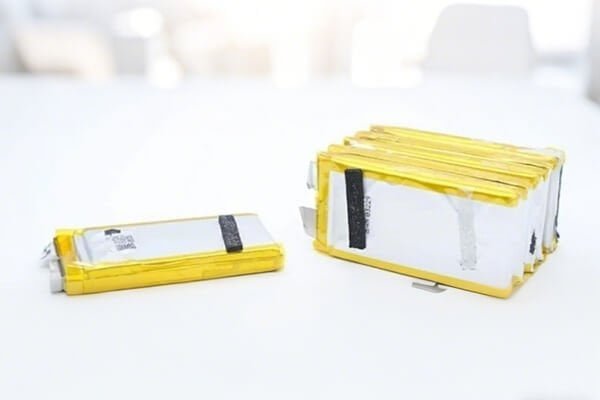
This choice is one of the most important decisions you'll make for your power system. At KKLIPO, we constantly guide clients through this decision, as the right battery S-count is fundamental to achieving a mission's goals. For a procurement manager like Omar, understanding this trade-off is key to sourcing a power solution that is both powerful and reliable. Let's look at what that extra voltage really means for performance.
What Does the "S" in 4S and 6S Actually Mean?
It's a simple letter, but it's the foundation of every performance difference. Is it a rating? A size? A brand?
The "S" stands for "Series," indicating how many individual battery cells are connected in series inside the pack. Each LiPo cell has a nominal voltage of 3.7V. A 4S battery has four cells in series, while a 6S battery has six.
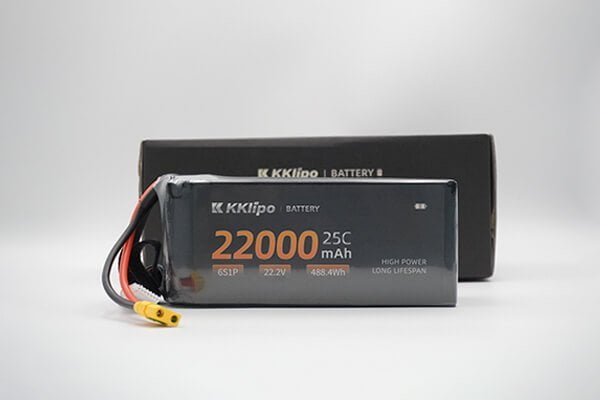
When you connect battery cells in series, their voltages add up. It’s like stacking batteries in a flashlight to get a brighter light.
- 4S LiPo Battery: 4 cells × 3.7V/cell = 14.8V Nominal Voltage (16.8V fully charged)
- 6S LiPo Battery: 6 cells × 3.7V/cell = 22.2V Nominal Voltage (25.2V fully charged)
This nearly 50% increase in voltage from 4S to 6S is the source of all the performance differences. Think of voltage as the "pressure" pushing electricity through the system. More pressure means more power.
Why Does Higher Voltage Mean Better Performance?
It seems counterintuitive that two batteries could have the same capacity (mAh) but deliver wildly different results. The secret isn't capacity; it's efficiency.
A 6S system runs more efficiently because it uses lower current to achieve the same amount of power as a 4S system. Lower current results in less heat loss in the motors, ESCs, and wiring, which translates to more power being delivered to the propellers.

The key formula to understand here is: Power (Watts) = Voltage (Volts) × Current (Amps).
Let's say you need 1000 watts of power to perform an aggressive maneuver with your drone.
- With a 4S Battery (14.8V): Your system needs to draw approximately 67.5 Amps (1000W / 14.8V).
- With a 6S Battery (22.2V): Your system only needs to draw about 45 Amps (1000W / 22.2V).
Drawing a lower current is a huge advantage. High current is the enemy of efficiency; it generates waste heat and puts stress on all your electronic components. By using a higher voltage, a 6S setup can do the same work with less effort. This means your motors and ESCs run cooler and can perform more reliably under sustained load, a critical factor for industrial applications.
How Do You Choose Between 4S and 6S?
One provides insane power, the other is more forgiving and cost-effective. The choice depends entirely on your equipment and your goals.
Choose 4S for entry-level use, smoother freestyle flying, or when cost is a major factor. Choose 6S for competitive racing, heavy-lift applications, and maximum power, but only if your electronics (ESC and motors) are rated for the higher voltage.
The most important rule is to check your equipment's specifications. Using a 6S battery on electronics designed for 4S will instantly destroy them. Your ESC and motors will have a voltage range printed on them (e.g., "Supports 3S-6S"). Never exceed this limit.
Here’s a quick guide:
| Characteristic | 4S LiPo | 6S LiPo |
|---|---|---|
| Performance | Strong, but smoother and more manageable. | Extremely powerful and aggressive. |
| Best For | Beginners, freestyle pilots, budget builds. | Racers, power-hungry pilots, professionals. |
| Cost | Lower (battery & components). | Higher (battery & components). |
| Compatibility | Works with a wider range of electronics. | Requires specific high-voltage ESCs & low-KV motors. |
| Weight | Lighter for the same capacity. | Heavier due to two extra cells. |
For FPV drone pilots, 4S is often preferred by beginners because the power delivery is more linear and easier to control. For experienced racers, 6S is the standard because the instant "punch" is necessary to win. For large aerial photography or industrial drones, 6S (or higher) systems are used to efficiently power large motors and carry heavy payloads.
Conclusion
The difference between 4S and 6S is voltage. 6S provides more power more efficiently, making it the choice for high performance, while 4S is a versatile, cost-effective option for many.