

You’ve loaded your drone with extra equipment for a critical mission, but halfway through, the low battery warning forces an early return. This mission failure directly impacts your operational success.
Yes, weight has a massive and direct impact on a drone’s battery life. Every gram added forces the motors to work harder and draw more power to generate the lift needed to stay airborne, drastically reducing flight time.
From a physics standpoint, this is non-negotiable. As a battery solutions provider, we constantly work with engineers to optimize the power-to-weight ratio. For a professional like you, Omar, understanding this relationship is not just theoretical—it's fundamental to mission planning and execution. The more weight a drone carries, the more energy it must expend simply to fight gravity, leaving less energy for actual flight.
How much power does extra weight really consume?
You might think a few hundred extra grams for a better camera is a minor addition. But in flight, this small increase in weight leads to a disproportionately large decrease in battery life.
The power required to sustain flight is roughly proportional to the weight raised to the power of 1.5. This means even a small increase in weight forces a significantly larger increase in power consumption, which rapidly drains your battery.
This isn't a simple one-to-one relationship; it's an exponential one. To keep a heavier drone hovering, the motors must spin faster to generate more lift. This increased demand for thrust requires a massive jump in electrical power. It's the same principle as you running on a treadmill. Running by yourself is easy. Now, imagine running at the same speed while wearing a heavy backpack—you'll get exhausted much faster. Your drone's battery feels the exact same strain. This is why, in professional applications, payload capacity is a critical design specification. Every component, from the camera to the sensors, is evaluated for its weight-to-performance ratio. As a manufacturer, we design batteries to handle these high power draws, but the laws of physics dictate that more weight will always equal less time in the air.
Can a bigger battery always guarantee longer flight time?
To compensate for a heavy payload, your first instinct is to use a larger battery. But you've noticed that doubling the battery capacity doesn't double your flight time, and sometimes it hardly helps at all.
No, a bigger battery isn't always the answer due to the law of diminishing returns. While a larger battery provides more energy, its own weight adds to the drone's total load. There is an optimal point where adding more battery weight cancels out the benefit of the extra capacity.
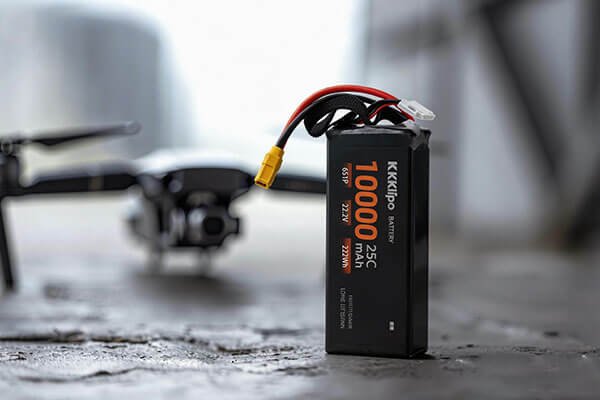
This is a critical balancing act in drone design, and one that we focus on when creating custom solutions for clients. Let's break it down. You add a heavier, higher-capacity battery. The good news is you have more "fuel" (Watt-hours). The bad news is the drone is now heavier, so its "fuel consumption" (power draw) increases just to stay in the air. Initially, the extra capacity outweighs the extra weight, and you get more flight time. But as you keep adding bigger and bigger batteries, you reach a point where the energy required to lift the battery itself consumes all the extra energy it provides.
| Scenario | Battery Capacity | Battery Weight | Total Drone Weight | Power Draw | Result |
|---|---|---|---|---|---|
| Standard | 5,000 mAh | 500g | 2,000g | 100% | 25 min flight |
| Upgrade | 7,500 mAh | 750g | 2,250g | 115% | 30 min flight (Not a 50% increase) |
| Extreme | 10,000 mAh | 1,000g | 2,500g | 130% | 28 min flight (Flight time decreases) |
This is why simply buying the biggest battery off the shelf is often a mistake. True optimization comes from finding that "sweet spot" for your specific airframe and payload.
What other factors work with weight to kill my battery life?
You've optimized your drone's weight, but your flight times are still inconsistent. Sometimes you get 30 minutes, and other times you're forced to land after 20, even with the same payload.
Beyond weight, factors like aggressive flying, high wind, and cold temperatures are major battery drains. The drone's flight controller must constantly adjust motor power to fight these forces, consuming significantly more energy than stable hovering in calm conditions.
Weight sets the baseline for your power consumption, but these external factors determine how much extra energy you'll use on any given flight. For your operations in diverse climates like the UAE and Russia, these are especially important.
- Flight Style: Frequent, rapid acceleration and high-speed maneuvers are like flooring the gas pedal in a car. Smooth, steady flight paths are far more energy-efficient.
- Wind: Flying against the wind requires constant, high power output just to maintain position. Even hovering in gusty conditions forces the motors to make thousands of micro-adjustments per second, which adds up to a significant power drain.
- Temperature: In cold weather, the chemical reactions inside a LiPo battery slow down, reducing its effective capacity. The battery might be 100% charged, but it can't deliver all of its stored energy.
- Altitude: At higher altitudes, the air is thinner. This means the propellers must spin much faster to generate the same amount of lift, leading to increased power consumption.
Understanding these variables is crucial for accurate mission planning and ensuring you always have enough power to return home safely.
Conclusion
Weight is the most critical factor affecting drone battery life. Every extra gram reduces flight time. For maximum endurance, minimize payload and account for environmental factors like wind and temperature.