

You hear "1/8 scale" and it sounds impressive, but it's an abstract number. This makes it impossible to visualize the true size or, more importantly, the power system it requires.
A 1/8 scale RC model car is substantial, typically measuring 50 to 65 cm (20-26 inches) long. Its large size and weight demand a powerful, high-capacity battery pack—often a 4S to 6S LiPo—making the power system as critical as the chassis itself.
As a manufacturer of high-performance power solutions, I often find that scale models are a perfect microcosm for understanding larger systems, like industrial drones. The physical size is the first thing people notice, but the real engineering challenge isn't the size of the chassis—it's the size and capability of the battery needed to move it effectively. The principles that apply to making a 1/8 scale monster truck perform are the exact same ones we use to power a heavy-lift drone. Let's break down the scale and then get to the part that really matters: the power.
How Is the Exact Size of a 1/8 Scale Model Determined?
You see different 1/8 scale models with varying dimensions, which is confusing. This inconsistency makes it difficult to judge the space you need or to accurately compare different platforms you might be evaluating.
The model's final size is determined by the dimensions of the real-world vehicle it's based on, divided by eight. A model of a long sedan will be significantly larger than a model of a compact off-road buggy, even at the same 1/8 scale.
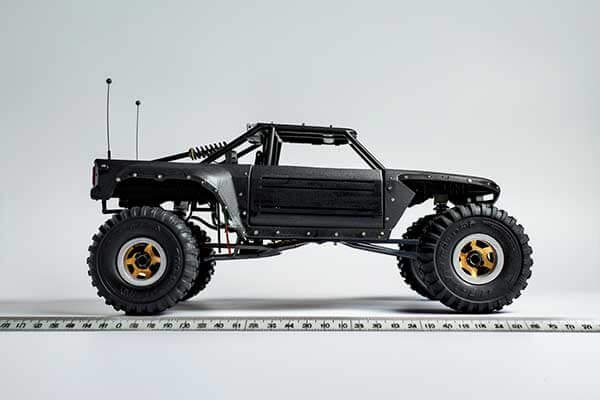
The term "1/8 scale" is a ratio, not a fixed measurement. The formula is simple: Model Dimension = Real Vehicle Dimension / 8. The variation comes from the vast differences in real-world vehicles. For instance, a 1/8 scale model of a Smart Fortwo would be tiny compared to a 1/8 scale model of a Ford F-150 pickup truck. In the RC world, most models are based on specialized racing vehicles, which gives us a more predictable range.
Here’s a practical breakdown:
| Real Vehicle Type | Typical Real Length | Calculated 1/8 Scale Length | Common RC Model Type |
|---|---|---|---|
| Full-Size Sedan (e.g., BMW 5 Series) | ~4,900 mm | ~612 mm (61 cm) | 1/8 On-Road / GT Car |
| Off-Road Trophy Truck | ~5,600 mm | ~700 mm (70 cm) | 1/8 Monster Truck |
| Off-Road Buggy | ~4,000 mm | ~500 mm (50 cm) | 1/8 Off-Road Buggy |
This physical size directly correlates to weight. A larger, heavier model requires significantly more force to accelerate and maneuver. This is where the conversation shifts from the chassis to the heart of the vehicle: the battery pack.
What Kind of Battery Does a 1/8 Scale Car Actually Need?
You see the large, aggressive frame of a 1/8 scale truck, but you don't know the power requirements. Choosing an underpowered battery will result in sluggish performance, while the wrong type can fail under the immense load.
A typical 1/8 scale RC car requires a high-voltage LiPo battery, usually a 4S (14.8V) to 6S (22.2V) pack. It must also have a high capacity (5000mAh+) for decent runtime and a very high discharge C-rating (50C or more) to handle extreme power demands.
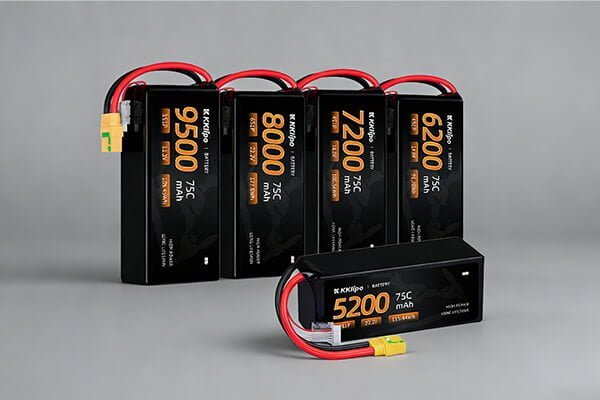
Powering a 3-5 kg vehicle and launching it over jumps requires an immense amount of current. The battery isn't just an accessory; it's the core of the vehicle's performance. Here’s what those specifications mean in a practical sense:
- Voltage (S Count): This is the "horsepower." A 4S pack is common for lighter 1/8 buggies, providing a great balance of power and control. For heavier monster trucks, a 6S pack is often used to provide the raw torque needed to move the vehicle's mass and achieve high speeds.
- Capacity (mAh): This is the "fuel tank." A higher milliamp-hour rating means longer runtimes between charges. For 1/8 scale, 5000mAh is a common starting point, with larger packs offering more runtime at the cost of increased weight.
- Discharge Rating (C-Rating): This is the most critical factor for high-performance applications. It measures how quickly the battery can safely discharge its energy. A 1/8 scale car's motor can draw over 100 amps in bursts. A low C-rating battery would overheat and fail, potentially destroying the battery and the vehicle's electronics. A high C-rating (50C, 100C, etc.) is essential.
How Does This Relate to Sourcing Batteries for Industrial Drones?
You might think this discussion about hobby cars is irrelevant to your work. This could cause you to overlook the fundamental principles of power systems that are directly applicable to your professional role in sourcing drone components.
The process of matching a battery's voltage, capacity, and discharge rate to a platform's weight, motor size, and performance goals is identical for a 1/8 scale car and a heavy-lift industrial drone. The scale is different, but the physics are the same.

As a procurement manager, you are constantly balancing performance requirements with physical constraints like weight and size. The 1/8 scale model is a perfect case study.
Consider the parallels:
- Platform Weight dictates Power Needs: A heavy 1/8 monster truck needs a 6S LiPo. A heavy-lift cinematography drone carrying a RED camera also needs a high-voltage system (e.g., 12S LiPo) to provide enough power to lift its all-up-weight. The core principle is the same: mass requires power.
- Mission Profile defines Battery Specs: A 1/8 race buggy needs a battery with an extremely high C-rating for rapid acceleration out of corners. An agricultural drone needs a battery with very high capacity (mAh) for maximum endurance to cover acres of land in a single flight. In both cases, the mission defines the most important battery specification.
- Power-to-Weight Ratio is King: In both worlds, adding a larger battery for more runtime increases weight, which in turn demands more power to maintain performance, creating a cycle of diminishing returns. Our job at KKLIPO is to find the optimal balance—the "sweet spot"—that delivers the required performance without overburdening the platform.
Conclusion
A 1/8 scale car is large, but its power system is the real story. Understanding how to power it teaches the core principles of matching battery performance to any demanding application, from a model truck to an industrial drone.