


You need to predict battery life for your equipment but keep getting vague answers. This uncertainty risks operational failure and complicates procurement, leaving you without reliable data for mission planning.
The lifespan of a 3.7V Li-ion cell is not a fixed time. It's calculated by dividing the battery's capacity (in mAh) by the device's average current consumption (in mA). Real-world factors like temperature and load will reduce this theoretical time.
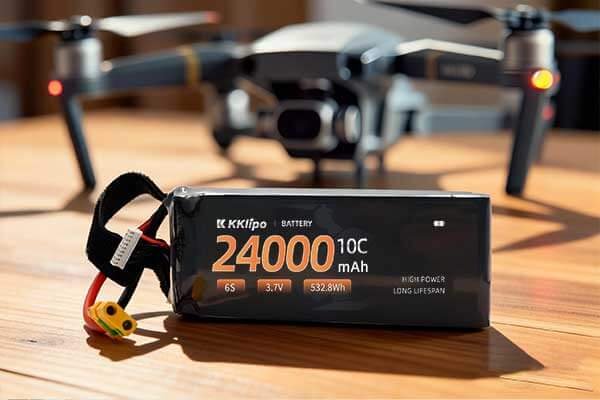
As a manufacturer of high-performance drone batteries, this is one of the most common questions I answer for procurement managers. Thinking that a 3.7V cell has a single "lifespan" is like asking how long a tank of gas lasts without knowing what car it's in. A high-performance drone will drain a battery far faster than a low-power sensor. To get a useful answer, we have to move beyond the question of time and start looking at the relationship between capacity and consumption.
How Do I Calculate the Theoretical Runtime of My Battery?
You have the battery specs but struggle to translate them into mission time. This makes it difficult to compare suppliers or promise specific performance levels to your end-users.
Use the formula: Runtime (hours) = Battery Capacity (mAh) / Device's Average Current (mA). For better accuracy, especially with fluctuating voltage, use: Runtime (hours) = Battery Energy (Wh) / Device's Average Power (W).

As an engineer, you'll appreciate that a precise calculation requires matching the right units. Let's break down the two main approaches.
Using mAh for a Quick Estimate
This is the most common method for a baseline estimate. If you have a 3000mAh battery and your device draws a steady 300mA, the math is simple: 3000mAh / 300mA = 10 hours. This is a great starting point for low-power, consistent-draw devices.
Using Wh for Better Accuracy
For devices with variable power needs, like a drone, using Watt-hours (Wh) is more accurate because it accounts for the total energy. A Watt-hour is the voltage multiplied by the amp-hours.
| Parameter | Value | Calculation |
|---|---|---|
| Battery Energy | 11.1 Wh | (3.7V x 3000mAh) / 1000 |
| Device Power | 1.5 W | (Measured) |
| Theoretical Runtime | 7.4 hours | 11.1 Wh / 1.5 W |
This method gives a more realistic figure because it measures total energy against total power, factoring in voltage variations during discharge.
Why Is My Actual Flight Time Always Shorter Than My Calculation?
Your theoretical calculations promise long flight times, but your field tests consistently fall short. This discrepancy erodes confidence in your equipment and makes mission planning a guessing game.
Your calculation is a perfect-world scenario. Real-world factors like high power demands during takeoff, low temperatures, battery age, and circuit inefficiencies all reduce the effective capacity. Expect a 20-30% reduction from the theoretical maximum.
The theoretical runtime is a number calculated in a lab, not in the harsh environments you operate in. As a procurement manager for regions like the Middle East or Russia, you know that temperature and load are not lab-controlled variables. Several key factors are constantly working against that ideal number.
Temperature: The Silent Capacity Killer
Li-ion batteries are chemical devices, and their performance is highly temperature-dependent.
- Cold: In low temperatures (below 0°C), the internal chemical reaction slows, drastically reducing the available capacity. A battery might only deliver 70% of its rated capacity in freezing weather.
- Heat: High temperatures accelerate battery aging and increase self-discharge, permanently reducing its lifespan.
High Discharge Rates
Drawing a large amount of current quickly, like during a drone's ascent, generates heat and stress. This inefficiency means the battery delivers less total energy than if it were discharged slowly. A battery rated at 3000mAh might only deliver 2700mAh under a heavy load.
Aging and Cycle Life
Every time you charge and discharge a battery, you cause a tiny amount of irreversible degradation. After 300-500 cycles, a typical Li-ion cell may only hold 80% of its original capacity.
How Can I Accurately Predict a Drone's Flight Time?
You need to provide reliable flight time estimates for complex missions. A simple average consumption figure isn't enough, leading to high-stakes guesswork in the field.
Profile your drone's power consumption across different flight phases: hover, forward flight, and high-load maneuvers. Use this data to create a weighted average, then apply a safety margin (e.g., 20%) to a high-quality battery's capacity.

For professional drone operations, a simple calculation is not enough. You need a more robust model. At KKLIPO, we work with clients to develop mission-specific performance profiles.
Step 1: Profile Your Drone's Mission
Instead of one average number, measure the current draw for each phase of a typical mission. You can get this data from a power analyzer or your flight controller's logs.
- Hover: 20A
- Forward Flight: 25A
- Heavy Lift/Climb: 40A
Step 2: Use a Weighted Average
Estimate the percentage of time the drone will spend in each phase.
- Hover (40% of time):
20A * 0.4 = 8A - Forward Flight (50% of time):
25A * 0.5 = 12.5A - Heavy Lift (10% of time):
40A * 0.1 = 4A - Weighted Average Current:
8 + 12.5 + 4 = 24.5A
Step 3: Calculate and Apply a Safety Factor
Now use this realistic average. For a 10,000mAh (10Ah) battery: 10Ah / 24.5A ≈ 0.4 hours, or 24 minutes. Finally, subtract a 20-25% safety margin to account for wind, temperature, and battery age, giving you a reliable flight time of about 18-20 minutes.
Conclusion
A cell's life depends on its capacity and the device's load. For accurate predictions, calculate theoretical runtime, then apply real-world factors and a safety margin for reliable mission planning.