

You expect long flights, but your drone's battery dies sooner than advertised. This cuts missions short and creates uncertainty, making it hard to plan reliable operations for your clients.
Most consumer drones fly for 20 to 35 minutes. However, this is an ideal number. Real-world flight time is often shorter due to factors like wind, temperature, and how aggressively you fly. FPV drones last 3-10 minutes, while professional models can exceed 45 minutes.
The number on the box is just a starting point. As a battery manufacturer, I want to show you what really determines your flight time. Understanding these factors is key to managing your fleet effectively and getting the most out of every single charge. The official specs are measured in a lab, but your work happens in the real world. Let's look at how flight time differs dramatically depending on the drone's mission.
Doesn't flight time vary greatly between different types of drones?
You see a tiny FPV drone and a large industrial drone but might not grasp the vast difference in their endurance. This can lead to poor purchasing decisions and unrealistic operational planning.
Yes, flight times vary massively. A racing FPV drone lasts 3-10 minutes, built for power. A consumer drone like a DJI Mavic offers 25-45 minutes for photography. Large industrial drones can fly for 30-55 minutes, balancing payload with endurance.
A drone's design purpose directly dictates its flight time. It's a constant engineering trade-off between weight, power, and battery capacity. At KKLIPO, we build specialized batteries for each of these categories because their power demands are completely different. An FPV battery is designed to deliver a huge burst of current, while an industrial battery is designed for sustained, reliable output under heavy load.
Here's a quick breakdown:
| Drone Type | Typical Flight Time | Primary Goal |
|---|---|---|
| FPV Racing Drone | 3 - 10 minutes | Agility & Speed |
| Consumer Drone | 25 - 45 minutes | Photography & Portability |
| Industrial Drone | 30 - 55 minutes | Payload & Endurance |
- Performance vs. Endurance: FPV drones are a perfect example. They use extremely powerful motors for acrobatics, consuming massive amounts of current. Their small, lightweight batteries are drained in minutes.
- Efficiency and Portability: Consumer drones are marvels of efficiency. They are engineered to be lightweight with optimized motors and software to maximize every milliamp-hour, pushing flight times toward the 45-minute mark.
- Payload and Power: Industrial drones are workhorses. They carry heavy sensors and need powerful motors, but they compensate with very large, often dual-battery systems.
Why does my battery drain so much faster on some days?
You plan a 25-minute flight based on a perfect day. But today, the battery warning screams after just 15 minutes, putting your drone and mission at risk of failure.
Wind is the biggest battery killer. Flying against the wind requires much more power. Cold temperatures also significantly reduce battery performance and can cut your flight time by 40%. Aggressive flying with rapid acceleration will drain your battery much faster.
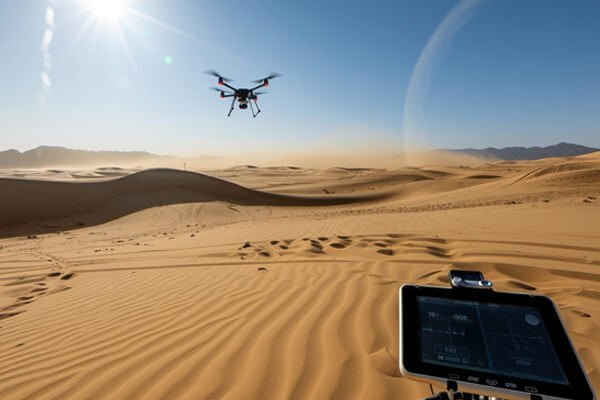
Your drone's battery is a chemical power plant, and its output is directly affected by its environment and the demands you place on it. The official flight time is measured in a perfect lab—no wind, constant speed, and room temperature. Your operations happen in the real world.
Environmental Battery Killers
- Wind: Think of it like walking against a strong current. Your drone's motors must work significantly harder just to hold their position, let alone move forward. A 15 mph headwind can easily cut your flight time in half. Always check the wind forecast before a critical mission.
- Cold: In temperatures near freezing (0°C / 32°F), the chemical reactions inside a LiPo battery slow down. The battery's internal resistance increases, and it cannot deliver its full power. This results in a drastic voltage drop and a much shorter flight time. Pre-warming your batteries is essential for winter operations.
Pilot-Induced Drain
- Flight Style: Every time you punch the throttle or make a hard turn, you create a huge power spike. Flying smoothly, like a commercial airliner, is far more efficient than flying like a fighter jet.
How can I get more flight time out of each battery?
Constantly worrying about your battery percentage ruins focus on the mission. You're always returning early, missing the perfect data capture because you're afraid of running out of power.
Fly smoothly and avoid aggressive maneuvers. In cold weather, keep batteries warm before takeoff. Remove unnecessary accessories to reduce weight. Most importantly, always land with at least 20-30% battery reserve. The best solution, however, is simply to carry spare batteries.
While you can't change the weather, you can change your habits to squeeze every last second of safe flight time from your packs. It's about being a smarter, more efficient pilot to maximize your time on station.
Practical Flight Tactics
- Be Gentle on the Sticks: Smooth, gradual inputs use far less energy than jerky, reactive movements. Think ahead and fly your lines with intention to conserve power.
- Manage Your Payload: Every gram counts. If you don't need that propeller guard or landing gear extension for a specific flight, take it off. Less weight means less work for the motors and a longer flight.
The Ultimate Solution
Ultimately, efficiency tricks only go so far. The most effective strategy to extend your operational time is not to stretch one battery, but to have more batteries. A multi-battery charging hub and a case of 3-4 fully charged, high-performance KKLIPO batteries transforms a 25-minute flight into a 1.5-hour operational window. This is the professional standard for ensuring mission success.
Conclusion
The average consumer drone flies for 20-35 minutes. Your real flight time depends on the drone, weather, and flying style. For serious work, always carry reliable spare batteries.