

You're trying to source batteries, but the voltage specifications vary widely across different models. Using the wrong voltage can damage expensive equipment, yet the "right" voltage for your needs isn't immediately obvious.
A drone battery's voltage depends on its number of internal cells, known as its "S" count. Most consumer drones use batteries between 11.1V (3S) and 22.2V (6S), while industrial drones can use 44.4V (12S) or even higher for greater power.
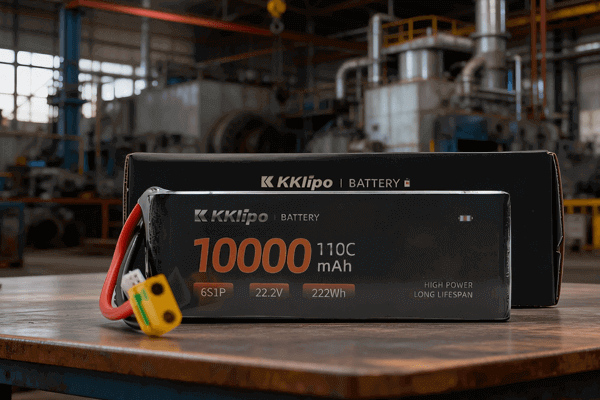
As a high-performance drone battery manufacturer, we know that voltage is one of the most critical specifications. It's not just a number; it dictates the power, performance, and compatibility of the entire system. For a procurement manager like you, Omar, a deep understanding of voltage allows you to source solutions that are not only compatible but are also optimized for the specific performance demands of your fleet, whether in the heat of the UAE or the cold of Russia.
What does the "S" count on a battery mean?
You see terms like "3S," "6S," and "12S" on spec sheets, but their direct impact on performance and compatibility isn't always clear. This makes it difficult to compare different battery options or understand why one is more powerful than another.
The "S" stands for "Series," indicating how many individual 3.7V LiPo cells are connected in series inside the battery pack. To find the battery's nominal voltage, you simply multiply the "S" count by 3.7V.
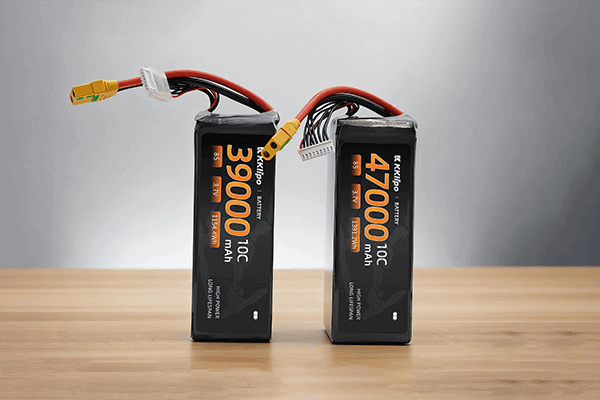
This is the foundational principle of drone battery design. Each individual lithium polymer (LiPo) cell has a nominal voltage of 3.7V (and a fully charged voltage of 4.2V). By linking them together in a chain, we increase the total voltage of the pack, which provides more power to the motors. When we design custom solutions at KKLIPO, the "S" configuration is one of the first parameters we establish with our clients to match their power requirements.
The Voltage Formula:
It's a simple calculation that you can use to decode any battery spec.
- Nominal Voltage: S-count × 3.7V
- Fully Charged Voltage: S-count × 4.2V
Here's how that translates to the most common configurations:
- 3S Battery: 3 cells × 3.7V = 11.1V (common in older or smaller drones)
- 4S Battery: 4 cells × 3.7V = 14.8V (popular for FPV and mid-size drones)
- 6S Battery: 6 cells × 3.7V = 22.2V (the standard for most modern high-performance consumer and prosumer drones)
- 12S Battery: 12 cells × 3.7V = 44.4V (used in heavy-lift industrial and agricultural drones)
Why has the industry shifted to higher voltage batteries?
You've noticed that newer, more powerful drones like the DJI Mavic 3 or Air 3 use 6S (22.2V) batteries, while older models used 3S (11.1V). You need to understand if this trend is just marketing or if it provides a tangible performance benefit for your operations.
The industry has moved to higher voltages because it is more efficient. A higher voltage system can deliver the same amount of power to the motors using less current, which generates less heat, improves motor performance, and can increase flight time.
This is where your engineering background becomes a key advantage. You already know the power formula: Power (W) = Voltage (V) × Current (A). To get 222 watts of power to a motor, you could use a 11.1V (3S) battery pulling 20 Amps, or you could use a 22.2V (6S) battery pulling only 10 Amps. Drawing less current is massively beneficial. It puts less stress on the battery, wiring, and ESCs (Electronic Speed Controllers), resulting in a more reliable and efficient system, which is crucial for operations in challenging environments.
The Benefits of High Voltage Systems:
This shift isn't arbitrary; it's driven by solid engineering principles.
| Feature | Low Voltage System (e.g., 3S) | High Voltage System (e.g., 6S) | Benefit for Operations |
|---|---|---|---|
| Current (Amps) | High | Low | Less heat, reduced stress on components, improved reliability. |
| Efficiency | Lower | Higher | More of the battery's energy is used for flying, not wasted as heat. |
| Performance | Less responsive | More power available for quick maneuvers, fighting wind, and lifting payloads. | Better flight stability and payload capacity. |
| Component Size | Requires thicker wires and larger ESCs. | Allows for thinner, lighter wires and more compact components. | Can contribute to a lighter overall drone build. |
For your work in the Middle East and Russia, the thermal efficiency of high-voltage systems is a significant advantage. Lower current means less heat buildup, which is a major factor for reliability when operating in the high ambient temperatures of the UAE.
How do you determine the correct voltage for a drone?
You're tasked with sourcing replacement batteries for a diverse fleet or components for a new custom build. Selecting a battery with the wrong voltage could lead to catastrophic failure, frying the electronics and causing the drone to fall from the sky.
The correct voltage is non-negotiable and is determined by the drone's Electronic Speed Controllers (ESCs) and motors. Always check the drone's official specifications or the labels on the original battery. Never mix voltages.
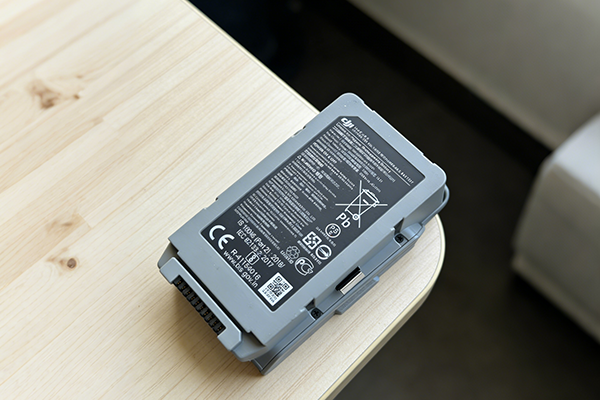
This is the most critical rule in battery management. Unlike capacity (mAh), where you have some flexibility, voltage is an absolute requirement. A drone's electronic components are designed to operate within a specific voltage range. Applying a voltage that is too high will instantly and permanently destroy them. As a manufacturer that offers full OEM/ODM capabilities, the first technical question we ask a client for a custom build is about their target voltage.
Three Ways to Verify Voltage:
There is no room for guesswork. Use one of these three methods to be certain.
-
Read the Battery Label: This is the most direct and reliable method. The original battery for the drone will have its nominal voltage (e.g., "22.2V") and its S-count (e.g., "6S") printed directly on the label. This is the voltage you must match.
-
Consult the Official Manual/Spec Sheet: The drone manufacturer's website or user manual will list the operating voltage range for the drone. This is the definitive source of truth.
-
Check the Drone App: When the drone is powered on, apps like DJI Fly will often display the real-time voltage of the battery. This is useful for monitoring health, but the label is the primary source for procurement.
The table below shows the required voltage for some common modern drones, highlighting the trend toward higher voltage systems.
| Drone Series / Model | Battery S-Count | Nominal Voltage | Fully Charged Voltage |
|---|---|---|---|
| DJI Mini 3 / Mini 2 SE | 2S | 7.4V | 8.4V |
| DJI Air 3 / Mavic 3 / Avata | 6S | 22.2V | 25.2V |
| DJI Inspire 3 | 12S (two 6S packs) | 44.4V | 50.4V |
| Heavy-Lift Agricultural Drone | 12S or 14S | 44.4V / 51.8V | 50.4V / 58.8V |
Conclusion
A drone battery's voltage is dictated by its cell count ("S" count) and must match the drone's electronics. Higher voltages are more efficient, which is why modern drones have adopted 6S and higher configurations.