

Staring at a wall of batteries and unsure which one you need? Choosing the wrong size is a common frustration, leaving you with a device that either won't fit or won't last.
Yes, a D battery is bigger than a C battery. It is larger in both physical dimensions (diameter and height) and has a much higher energy capacity. D batteries are designed for high-power devices, while C batteries are for medium-power applications.
While this might seem like a simple consumer question, the core principle—matching a power source's size and capacity to its intended application—is fundamental to everything we do in the world of high-performance drone batteries. For procurement experts like Omar, this concept of energy density and application-specific design is critical on a much larger scale. Let's break down the key differences between these two common battery types.
How Do Their Physical Sizes and Capacities Compare?
Ever wondered why a powerful flashlight needs a huge D battery while a smaller toy works fine with a C? It's not just about fitting in the slot; it's a matter of runtime and power delivery.
A D battery is significantly larger, allowing it to hold two to three times more energy than a C battery. While a C battery has a capacity around 6,000-8,000 mAh, a D battery typically holds between 12,000 and 20,000 mAh.
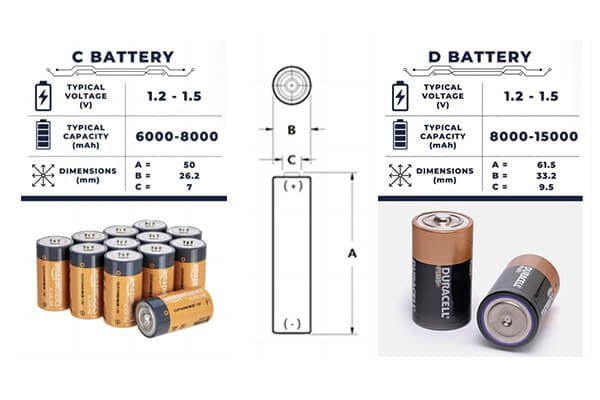
At KKLIPO, our work is all about maximizing energy in a given weight and volume. The same principle applies here, just on a different scale. The physical size of a battery case is a direct indicator of how much chemical material it can hold inside. More material means a greater capacity for storing energy. This capacity, measured in milliamp-hours (mAh), determines how long the battery can power a device. A higher mAh rating means a longer runtime. The difference is not minor; a D battery offers substantially more energy, making it suitable for more demanding jobs.
| Feature | D Battery | C Battery |
|---|---|---|
| Diameter | ~34.2 mm | ~26.2 mm |
| Height | ~61.5 mm | ~50.0 mm |
| Typical Capacity | 12,000 - 20,000 mAh | 6,000 - 8,000 mAh |
| Primary Use | High-power, long-endurance devices | Medium-power devices |
If They Have the Same Voltage, Why Choose One Over the Other?
If you test a new C and a new D battery, both will show 1.5 volts. This leads many people to think they are interchangeable, but using the wrong one will lead to disappointment.
Even though the voltage is the same, the choice depends entirely on the device's energy demand. D batteries are built for high-drain applications, while C batteries are for moderate-drain devices. Using a C battery in a D-battery device will result in extremely short runtime.

Think of voltage as the water pressure in a pipe—it's the force pushing the energy out. Capacity (mAh) is like the size of the water tank. Both C and D batteries have the same "pressure" (1.5V), but the D battery has a much, much larger "tank." Therefore, you choose the battery based on how much "water" your device needs over time. A small lamp sips power, so a smaller tank (C battery) is fine. A huge searchlight gulps power, so it needs the giant tank (D battery) to run for any reasonable amount of time.
Common Uses for Each Type
-
D Batteries (High-Drain): These are the workhorses. You'll find them in devices that need a lot of power or need to run for a very long time.
- Large, high-lumen flashlights and searchlights
- Portable boomboxes and amplifiers
- Major motorized toys
- Some older, large portable radios
-
C Batteries (Medium-Drain): These are for everyday devices that have a moderate power draw.
- Medium-sized flashlights and camping lanterns
- Many children's toys
- Portable fans or radios
Never try to force a battery into a device it wasn't designed for. A D battery won't physically fit in a C slot, and while a C battery might make contact in a D slot, its low capacity will make it practically useless.
Conclusion
Simply put, a D battery is bigger and holds significantly more energy than a C battery. Choosing the correct one is essential for making sure your device performs as expected.