

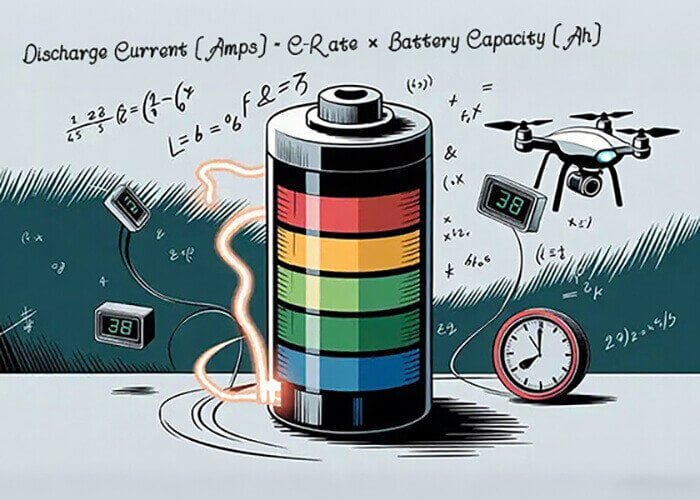
Seeing a term like "C1" on a battery specification sheet can be confusing. It looks like technical jargon, and ignoring it can mean choosing a battery that fails to deliver the performance you need.
"C1" on a battery specifies its rated capacity when discharged completely in one hour. It is a critical benchmark that measures the battery's ability to perform under a relatively high and sustained load, making it a key indicator for high-power applications.

This single term tells a much bigger story about a battery's capabilities. For us at KKLIPO, and for procurement experts like Omar who source power solutions for demanding industrial drones, understanding what C1 means is fundamental. It's the language we use to accurately compare performance and match a power source to a mission. Let's break down this crucial concept.
What Is the "C-Rate" and Why Does It Matter?
Before you can understand C1, you have to understand the "C-rate." Is it a unit? A measurement? It's actually a way of describing speed.
The C-rate simply describes how fast a battery is being charged or discharged relative to its maximum capacity. "C" stands for the capacity of the battery, and the number next to it represents a multiplier.
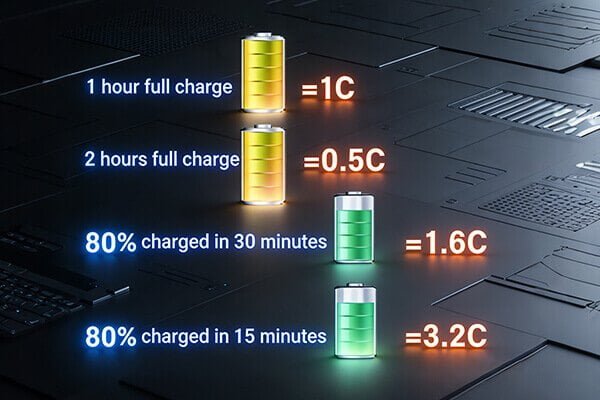
Think of "C" as the size of your battery's fuel tank, measured in Amp-hours (Ah) or milliamp-hours (mAh). The C-rate is how fast you're draining that tank. The formula is simple:
Discharge Current (Amps) = C-Rate × Battery Capacity (Ah)
Let's use a 100Ah battery as an example to make this clear.
- A 1C Rate: This means you are drawing a current equal to the battery's capacity. For our 100Ah battery, a 1C discharge rate is 100 Amps. At this rate, the battery would theoretically be drained in 1 hour.
- A 2C Rate: This is twice the 1C rate. You would be drawing 200 Amps (2 x 100Ah). At this high rate, the battery would be drained in just 30 minutes.
- A 0.5C Rate (or C/2): This is half the 1C rate. You would be drawing 50 Amps (0.5 x 100Ah). At this lower rate, the battery would last for 2 hours.
The C-rate is the universal language for talking about battery charge and discharge speeds.
Why Is a C1 Rating Different From a C20 Rating?
You might see two batteries, both labeled 100Ah. But one is rated at C1, and the other at C20. This is a critical difference that determines their ideal use.
A battery's usable capacity changes with the discharge rate. A C20 rating measures capacity over a slow, 20-hour discharge, while a C1 rating measures it over a fast, 1-hour discharge. The C1 test is more demanding, so the resulting capacity number is often lower for the same battery.

This might seem strange, but a battery is not a perfect fuel tank. The faster you try to pull energy out of it, the more energy is lost to internal resistance and chemical inefficiencies. Think of it like trying to empty a large jug of water. If you tip it over gently (a low C-rate like C20), you can pour out almost all the water. If you turn it completely upside down to empty it fast (a high C-rate like C1), more water splashes out and is wasted.
Comparing C1 and C20 in Practice
Let's go back to our 100Ah battery.
- 100Ah (C20): This means the battery can deliver 5 Amps (100Ah / 20 hours) for 20 hours. This is a common rating for deep-cycle batteries used in solar storage or RVs, where the power draw is low and steady. If you tried to draw 100 Amps from this battery, it would likely die much faster than one hour and might only deliver 80Ah of usable energy.
- 100Ah (C1): This means the battery is proven to deliver 100 Amps for one hour. This rating is essential for high-power applications.
| Rating | Discharge Rate | Typical Application | Performance Focus |
|---|---|---|---|
| C1 | High Current (1-hour discharge) | Drones, EVs, Power Tools | High-Power Output |
| C10 | Medium Current (10-hour discharge) | Telecom Backup, UPS Systems | Balanced Performance |
| C20 | Low Current (20-hour discharge) | Solar Storage, Marine, RVs | Long-Duration Endurance |
When comparing batteries for a demanding job, you must compare them at the same C-rate. A C1-rated battery is built for power.
How Do I Use This C1 Information in the Real World?
Knowing what C1 means is one thing; using it to make the right choice is another. How do you apply this to your own needs?
Use the C1 rating to confirm a battery can truly meet your device's power demands. It allows for a true apples-to-apples comparison between batteries intended for high-performance applications. It's a guarantee of high-rate capability.
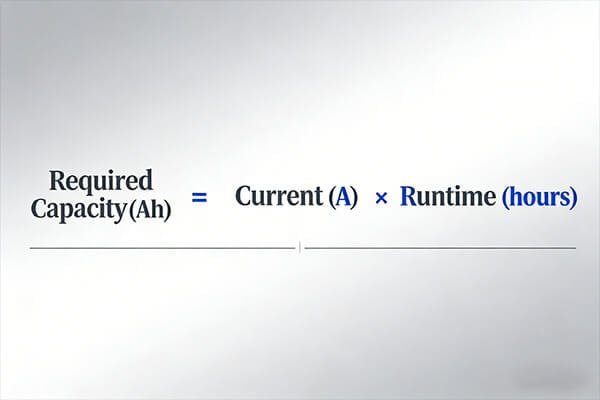
Let's make this practical. Imagine you are sourcing a battery for a piece of equipment that requires a constant 50 Amps and needs to run for at least 2 hours.
-
Calculate Your Need:
Required Capacity (Ah) = Current (A) × Runtime (hours)50A × 2h = 100AhYou need a battery that can deliver at least 100Ah. -
Select the Right Battery: You could choose a battery rated at 120Ah (C20). However, your 50A draw is a C/2.4 rate (120Ah / 50A = 2.4 hours), which is a fairly high current. A better, safer choice would be a battery rated at 100Ah (C1). This guarantees that the battery is designed and tested to handle a 100A draw, which is double your requirement. It ensures the battery will not be overworked, will perform reliably, and will have a longer service life.
Finally, don't confuse the C-rate "C" with other uses of the letter on a battery. It is not the "C" in °C for temperature, nor is it the "C" in a battery model like CR2032, where it denotes the battery's chemistry.
Conclusion
The C1 rating on a battery is a powerful spec, defining its capacity under a demanding one-hour discharge. It is the key benchmark for evaluating true performance in high-power applications.