

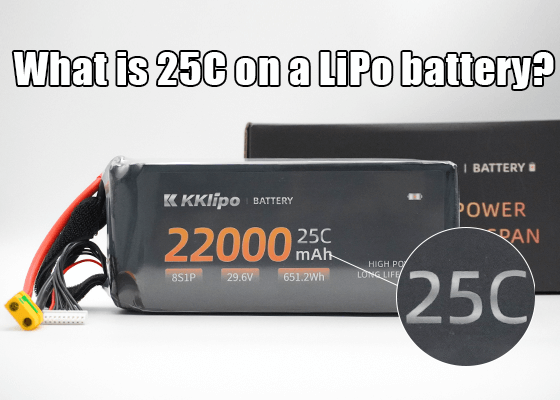
Are you selecting batteries based only on voltage and capacity, ignoring the "C" rating? This common oversight can lead to sluggish drone performance, overheating packs, and a shortened battery lifespan. Let’s clarify this crucial number.
"25C" is the battery's maximum safe continuous discharge rate. It means the battery can deliver a current equal to 25 times its own capacity without being damaged. For a 5000mAh (5Ah) battery, this translates to a maximum continuous output of 125 Amps (5 x 25 = 125).
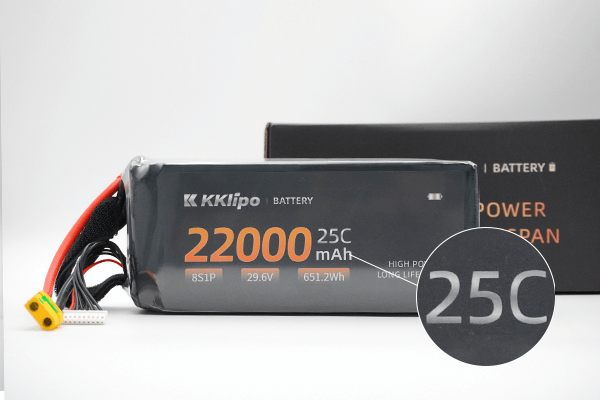
In my experience at KKLIPO, I see many clients purchase batteries that are technically compatible but underpowered for their mission. A 25C battery is a solid baseline for many applications, but it is not a "one-size-fits-all" solution. For a procurement manager like Omar, understanding where 25C fits—and where it falls short—is essential for ensuring fleet reliability and avoiding costly failures, especially in demanding environments like Russia or the Middle East. Let's dig deeper into what this number really means for you.
How do you calculate the actual current of a 25C battery?
The "25C" label by itself is meaningless. It is just a multiplier. You must combine it with the battery's capacity to understand its true power output.
To find the maximum continuous Amps your battery can deliver, convert its capacity from mAh to Amp-hours (Ah) and multiply by 25. For example, a 2200mAh (2.2Ah) battery can supply 55 Amps continuously (2.2 x 25 = 55).
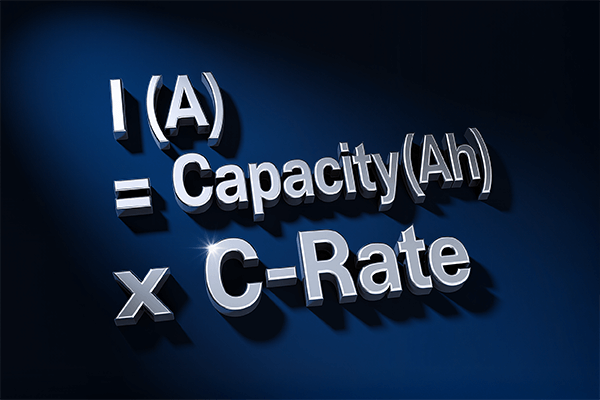
As a manufacturer, I always stress this point: a bigger battery with the same C-rating is more powerful. Think of it like a water pipe. The C-rating is the pressure, but the capacity is the size of the tank behind it.
Let's compare two different 25C batteries we might produce:
-
For a Small Survey Drone:
- Capacity: 2200mAh (2.2Ah)
- Calculation: 2.2 Ah × 25 = 55 Amps maximum continuous draw.
-
For a Larger Agricultural Drone:
- Capacity: 16,000mAh (16Ah)
- Calculation: 16 Ah × 25 = 400 Amps maximum continuous draw.
Both are "25C" batteries, but their capabilities are worlds apart. The first can power a lightweight mapping drone, but it would instantly fail on a heavy-lift system. The second can handle significant payloads. Before you procure any battery, you must know the maximum current your drone's motors will pull at full throttle and ensure your battery's calculated Amp output exceeds that number. We recommend a 20-30% safety margin.
| Battery Capacity | C-Rating | Max Continuous Amps | Typical Application |
|---|---|---|---|
| 1500mAh (1.5Ah) | 25C | 37.5 A | RC Planes, Small Drones |
| 5000mAh (5.0Ah) | 25C | 125 A | Mid-size Quadcopters, RC Cars |
| 22000mAh (22Ah) | 25C | 550 A | Large Agricultural/Industrial Drones |
What does the second number on a "25C/50C" battery mean?
Often, you will see two numbers separated by a slash. Ignoring the difference between them can lead to dangerously overheating your battery.
The first number (25C) is the maximum continuous discharge rate for the entire flight. The second number (50C) is the burst or peak rate, which the battery can sustain for only a few seconds during high-power maneuvers.
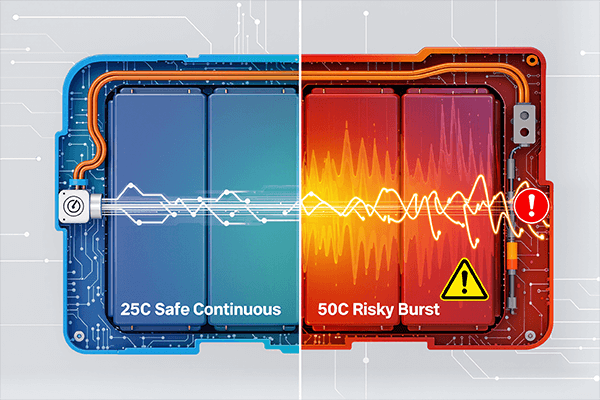
Think of it like running. The continuous 25C rating is your jogging pace—you can keep it up for a long time. The burst 50C rating is a short sprint—useful for jumping over an obstacle but impossible to maintain.
For a 2200mAh (2.2Ah) battery labeled "25C/50C":
- Continuous Power: 2.2Ah × 25 = 55 Amps. Plan your entire flight system around this number.
- Burst Power: 2.2Ah × 50 = 110 Amps. This is your emergency power for a sudden climb or recovery, lasting only 5-10 seconds.
Relying on the burst rating is a common mistake that leads to puffed batteries. If your drone requires 80 Amps continuously, you might see the 110 Amp burst rating and think this battery is sufficient. It is not. The battery will be forced to operate in its burst range constantly, causing its internal temperature to skyrocket. This is especially dangerous in hot climates.
At KKLIPO, we engineer our industrial batteries to be robust, but the laws of chemistry apply to everyone. Always design your power system based on the continuous C-rating to ensure safety and longevity. The burst rating is a temporary safety net, not a performance target.
Is 25C a good enough rating for my drone?
Just because a 25C battery can power your drone doesn't mean it's the right choice. The C-rating is about performance headroom and battery health, not just basic function.
A 25C rating is suitable for low-to-moderate-power applications like long-endurance mapping or surveillance. For high-performance tasks like heavy lifting or racing, a higher C-rating (e.g., 45C+) is necessary to prevent voltage sag and overheating.
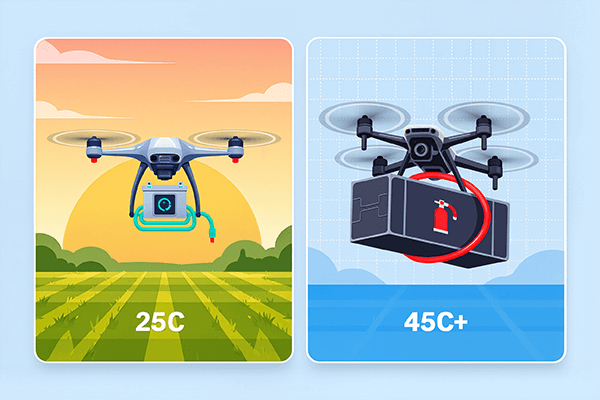
Let's use the water tank analogy. The battery's capacity (mAh) is the amount of water in the tank. The C-rating is the size of the pipe coming out. A 25C battery is like a standard garden hose. It’s perfect for watering plants (a low-current, steady flight). But if you try to use that same hose to fight a fire (a high-current, heavy-lift takeoff), the flow is too weak. You need a fire hose (a high C-rating battery).
When is 25C the right choice?
- Endurance Missions: If your drone cruises at 40% throttle for an hour, the current draw is low. A 25C battery is efficient and often lighter than higher C-rated packs, maximizing flight time.
- Budget-Conscious Operations: 25C cells are typically more cost-effective to manufacture.
When is 25C the wrong choice?
- Heavy-Lift Drones: Lifting a heavy payload demands massive current. A 25C battery will experience severe voltage sag, making the drone feel unstable and sluggish.
- High-Agility Drones (FPV/Racing): Punching the throttle requires instant power. The lower internal resistance of a high C-rating battery provides this "punch," while a 25C pack will feel soft.
For my clients in demanding fields, I always recommend choosing a C-rating that provides at least 30% more current than their system's maximum continuous draw. This headroom keeps the battery cool, extends its cycle life, and ensures you have power when you need it most.
Conclusion
The 25C rating on a LiPo battery is a multiplier that defines its maximum continuous current output. It is a solid baseline for moderate-power applications but is insufficient for high-demand tasks, where a higher rating is required for safety and performance.