


You’re reviewing spec sheets for a new high-performance drone and see "6S LiPo" listed as the required power source. You know it means more power, but choosing the right battery pack involves more than just matching a number—it impacts motor selection, flight controller settings, and overall system safety.
A 6S LiPo battery is a high-voltage power pack made of six Lithium Polymer (LiPo) cells connected in series ("S"). This configuration multiplies the voltage of the individual cells, resulting in a nominal voltage of 22.2V and a fully charged voltage of 25.2V for powerful applications.
At KKLIPO, we specialize in creating these high-power solutions for professional drone applications. For a procurement manager like you, Omar, a deep understanding of what "6S" signifies is critical. It's not just a label; it's the foundation of a high-performance powertrain. Let's decode what these numbers mean for your fleet's performance and safety.
How is the voltage of a 6S battery determined?
You see different "S" ratings like 3S, 4S, and 6S. You need to understand exactly how the "S" number translates to the voltage that will be running through your drone's electronics, as a mismatch here can be catastrophic.
The "S" stands for "Series." A 6S battery has six individual 3.7V cells connected in series. In a series circuit, voltage adds up. Therefore, the total nominal voltage is simply six times the voltage of a single cell.
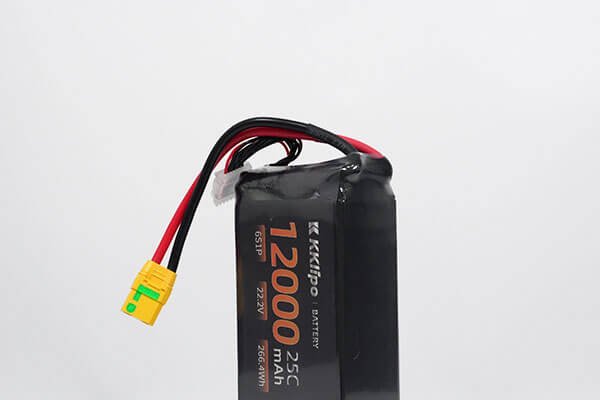
This is the fundamental principle of creating high-voltage LiPo packs. A single LiPo cell has a standard voltage range that you must know. When we build a 6S pack, we are essentially creating a powerful battery by stacking these cells electrically. For a professional overseeing a fleet, it's crucial to understand the three key voltage states of the pack, as they dictate everything from component compatibility to operational safety protocols.
The Three Critical Voltages of a 6S Pack
| Voltage State | Per Cell | 6S Pack Total (6 x Cell Voltage) | Importance for Procurement |
|---|---|---|---|
| Nominal Voltage | 3.7V | 22.2V | This is the "label" voltage, used for general classification and matching with motors that have a specific KV rating. |
| Fully Charged Voltage | 4.2V | 25.2V | This is the most critical number. Your drone's ESCs and other electronics must be rated to handle this peak voltage, or they will be destroyed. |
| Storage Voltage | ~3.8V | ~22.8V | The safest voltage for long-term storage to maximize battery lifespan and minimize fire risk in your warehouse. |
What do capacity and C-rating mean for a 6S battery?
You've selected a 6S battery, but now you see more numbers like "5000mAh" and "75C." You know these relate to flight time and power, but you need to know precisely how they affect a drone's performance and whether a higher number is always better.
Capacity (mAh) is the battery's "fuel tank," determining how long it can run. The C-Rating is the "fuel hose," defining how fast that energy can be delivered to the motors. A mismatch can lead to poor performance or permanent battery damage.
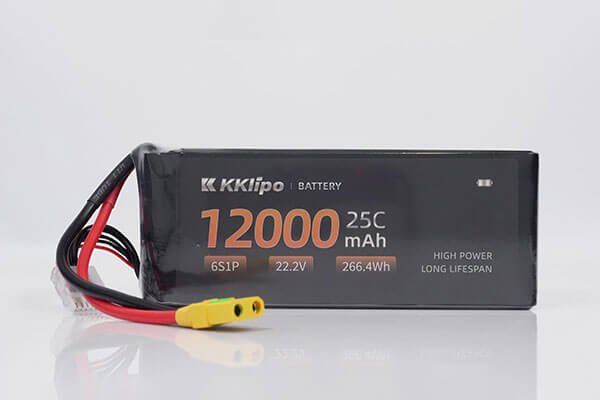
These two specifications work together to define the battery's total power output capability. For high-performance drones, especially in demanding environments like those in the Middle East or Russia, having an adequate C-rating is a matter of flight safety, not just performance. When a drone performs an aggressive maneuver, the motors demand a massive surge of current. If the battery's C-rating is too low, it can't supply this current. This results in a voltage drop (voltage sag) that can cause the drone to lose power, or in the worst case, fall out of the sky.
Calculating Maximum Power Output
- Capacity: Measured in milliamp-hours (mAh). A 5000mAh battery can supply 5000 milliamps (5 amps) for one hour.
- C-Rating: A multiplier. To find the maximum continuous discharge current, you multiply the capacity (in Amp-hours) by the C-rating.
Formula: Max Continuous Amps = Capacity (Ah) × C-Rating
For a 6S 5000mAh 75C battery:
- Convert mAh to Ah: 5000mAh = 5.0Ah
- Calculate: 5.0Ah × 75C = 375 Amps
This means the battery can safely provide up to 375 amps of continuous current to power your drone's motors. Always choose a C-rating that provides a healthy margin above your motors' maximum combined current draw.
Why is the small white connector on a 6S battery so important?
You notice every 6S pack has a large power plug and a smaller, multi-pin white plug. You need to know if this small plug is just an accessory or a critical component for battery health and safety, as it often complicates charging setups.
That small white plug is the balance connector, and it is absolutely essential for the safety and lifespan of any multi-cell LiPo battery. It allows the charger to monitor and adjust the voltage of each of the six cells individually.
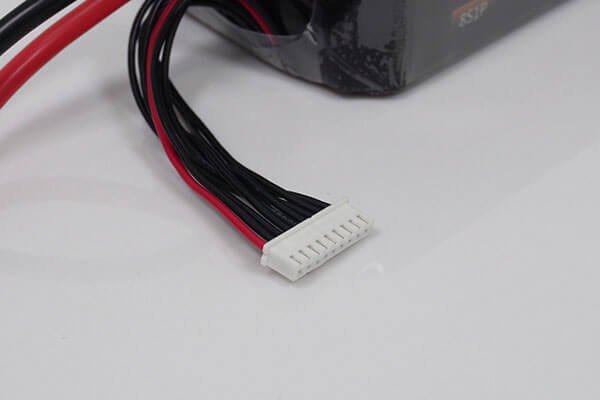
During use, the six cells inside your 6S pack will never discharge at precisely the same rate. Over time, this leads to a voltage imbalance—one cell might be at 3.6V while another is at 3.8V. If you were to charge this pack without a balance connector, the charger would only see the total voltage. It would stop when the total hits 25.2V, but by then, the higher-voltage cell might be dangerously overcharged (e.g., to 4.3V), while the lower one remains undercharged. An overcharged LiPo cell is a severe fire hazard. Balance charging is a non-negotiable safety protocol. A 6S battery will have a 7-pin balance connector—one ground pin and one positive pin for each of the six cells.
Conclusion
A 6S LiPo is a 22.2V power pack for high-demand applications. Understanding that "S" means voltage, "mAh" means runtime, and "C" means power output is crucial for sourcing the correct and safe battery for your drones.