


Flying a professional drone with uncertified batteries is a gamble that risks both your expensive equipment and your business reputation. You need to know which safety marks actually matter.
For solid-state drone batteries, the most critical certifications are UN38.3 for legal transport and MSDS for chemical handling. Additionally, look for IEC 62133 and UL 1642 to ensure the cells can withstand overcharging, physical impact, and extreme temperatures without thermal runaway.
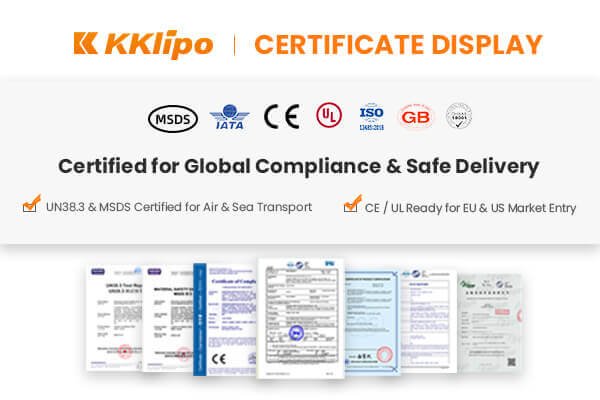
Many pilots ignore the fine print on the back of a battery pack. But as a manufacturer at KKLIPO, I can tell you that those tiny logos are the difference between a successful mission and a liability nightmare. Let's break down what you need to see on the label.
What are the absolute minimum certifications required for shipping?
You can buy the best battery in the world, but if it cannot legally get on a plane or a truck, it is useless to your operations.
Every drone battery must have UN38.3 certification to prove it is safe for air, sea, or ground transport. You also need a Material Safety Data Sheet (MSDS) to define the chemical composition and handling procedures for emergency responders.
The Passport for Your Battery Think of UN38.3 as the passport for your battery. Without it, the battery cannot travel. This is not just a sticker; it is a rigorous series of tests defined by the United Nations Manual of Tests and Criteria. Whether you are shipping samples from our factory in China to Omar in the UAE, or carrying batteries on a commercial flight for a shoot, this is mandatory.
What does UN38.3 actually test? It subjects the battery to eight specific torture tests to ensure it won't explode during transport.
| Test Code | Test Name | Purpose |
|---|---|---|
| T1 | Altitude Simulation | Simulates low pressure in an airplane cargo hold at 15,000 meters. |
| T2 | Thermal Test | Rapid temperature changes between -40°C and +75°C. |
| T3 | Vibration | Simulates the shaking of a truck or rough flight. |
| T4 | Shock | Simulates dropping or hard impacts during handling. |
| T5 | External Short Circuit | Ensures the battery doesn't catch fire if terminals touch. |
| T6 | Impact/Crush | Tests the physical integrity of the cell casing. |
| T7 | Overcharge | Ensures the battery can handle accidental overcharging. |
| T8 | Forced Discharge | Tests the battery's reaction to being completely drained. |
The Role of MSDS The Material Safety Data Sheet (MSDS) acts as the ID card. It doesn't test performance, but it tells logistics companies exactly what chemicals are inside. For solid-state batteries, this is crucial because the chemistry differs from standard liquid LiPos. It informs firefighters how to extinguish the battery if an accident happens. Always ask your supplier for the PDF version of the MSDS before placing an order.
Which standards guarantee the battery is safe to fly?
Transport safety is one thing, but you need to know the battery won't fail during a high-stress mission when the drone is under heavy load.
Look for IEC 62133 and UL 1642 certifications. These international standards rigorously test the battery for internal short circuits, crush resistance, and overcharging resilience, ensuring the battery remains stable even when the drone is pushed to its limits.
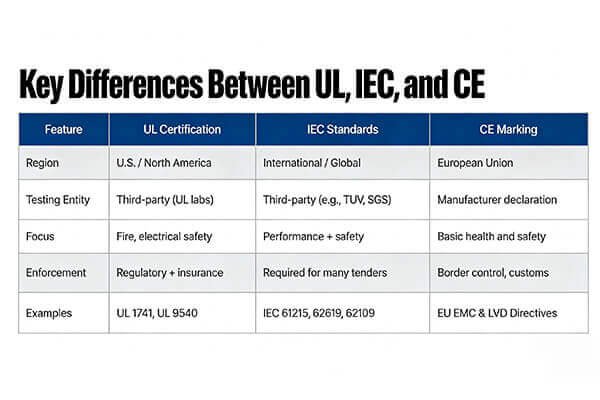
Beyond Shipping: Operational Safety While UN38.3 is about moving the battery, UL (Underwriters Laboratories) and IEC (International Electrotechnical Commission) standards are about using the battery. For a procurement manager like Omar, these are the standards that lower your insurance premiums and ensure compliance with safety audits.
Key Standards Explained:
- UL 1642: This is the standard specifically for lithium battery cells. It focuses on "abuse" scenarios.
- The Projectile Test: They heat the battery until it explodes (if it does). The standard requires that no part of the burning battery penetrates a wire screen mesh. This is vital for pilot safety.
- The Crush Test: A hydraulic ram crushes the battery. Solid-state batteries excel here because they don't leak flammable liquid when crushed.
- IEC 62133: This is the global benchmark for portable electronic batteries. It is generally broader than UL and is often required for entering markets in Europe and Asia. It covers continuous low-rate charging and thermal abuse.
- CE Mark: If you are operating in Europe, the CE mark is mandatory. It declares that the product meets EU safety, health, and environmental requirements. However, be careful—many low-quality factories fake this mark. CE is a self-declaration, whereas UL and IEC require third-party lab testing.
The "Solid State" Advantage in Testing Solid-state batteries are famous for passing the Nail Penetration Test. In this test, a steel nail is driven through the fully charged battery.
- Traditional Battery: Usually bursts into flames instantly.
- Solid State Battery: Typically sees a small temperature rise but no fire. While there isn't a specific "Nail Test Certification" logo, look for test reports referencing GB/T 31485 or specific UL abuse test sections that document this performance.
Are there new standards specifically for solid state technology?
Battery technology moves fast, and old standards designed for liquid electrolytes might not capture the full potential or specific requirements of new solid-state designs.
New standards like GB/T 46460-2025 and T/CI 1000-2025 are emerging to specifically address high-performance aviation batteries. These advanced protocols focus on the unique properties of solid-state tech, setting higher benchmarks for energy density and thermal stability.

The Future of Regulation We are entering a new era. The old rules were written for batteries that leak. The new rules are for batteries that are solid. As a manufacturer in China, where the supply chain is moving fastest, I am seeing new standards that will define the next decade of drone aviation.
Upcoming Standards to Watch:
- GB/T 46460-2025: This is a comprehensive national standard for "Unmanned Aerial Vehicle" batteries. Unlike general battery standards, this one specifically addresses the vibration frequencies, G-forces, and discharge rates unique to drones. If a battery meets this, it is truly "Aviation Grade."
- T/CI 1000-2025: This targets low-altitude economy flight (100m - 1000m). It sets stricter requirements for thermal runaway. It basically demands that if one cell fails, it must not propagate to the neighboring cells. Solid-state batteries are the best candidates to pass this.
How to Verify You Aren't Being Scammed There are many "fake" batteries on the market with printed logos but no testing.
- Ask for the Report: Do not just look at the sticker. Ask me (or your supplier) for the full "Test Report." It should be a PDF document from a certified lab (like Intertek, TUV, or SGS).
- Check the ID: The report will have a sample ID and photos. Match the photos in the PDF to the battery you are holding.
- Verify the Dates: Standards update. A UN38.3 test from 2010 might not be valid today. Ensure the report is recent (within the last 2-3 years).
Why This Matters for KKLIPO At KKLIPO, we ensure our semi-solid and solid-state batteries undergo these specific tests. We know that for B2B clients, a piece of paper is just as important as the battery itself because it allows you to fly legally and safely.
Conclusion
Prioritize UN38.3 and MSDS for logistics, then demand UL 1642 or IEC 62133 for operational safety. These certifications turn a promising technology into a reliable, insurable asset for your fleet.