

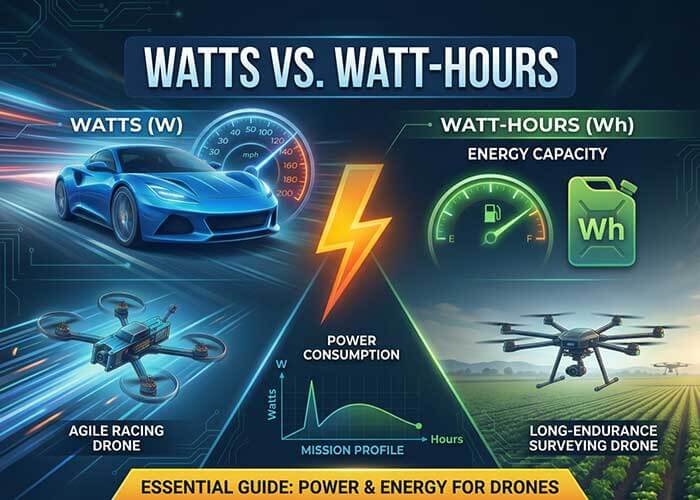
You're comparing batteries and feel lost in the jargon. One spec sheet emphasizes a high Watt rating, while another highlights a large Watt-hour capacity. This makes it impossible to know which battery will actually meet your drone's flight time and performance needs.
Watts (W) measure power, which is the rate at which energy is used, like a car's horsepower. Watt-hours (Wh) measure total energy capacity, like the size of a car's fuel tank. You need both to understand a battery's performance.
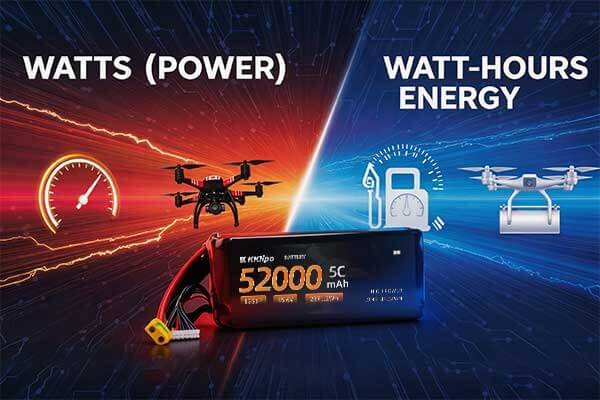
As a procurement manager for high-value drone fleets, I've seen how this common confusion can lead to costly purchasing mistakes. Buying a battery with the wrong balance of Watts and Watt-hours means you either can't power your drone correctly or you get unacceptably short flight times. Mastering this distinction is fundamental. It empowers you to move past marketing claims and select batteries based on the specific performance metrics that matter for your missions. Let's break down what each unit means for your real-world operations.
What Do Watts Tell Me About a Battery's Performance?
You're looking at a heavy-lift drone that requires a huge burst of power to get off the ground with a payload. You need to know if a potential battery can handle this demand without failing or damaging the drone.
Watts (W) tell you the battery's maximum power output—its ability to deliver energy quickly. A high Watt rating is crucial for drones that need strong, instantaneous power for takeoffs, quick maneuvers, or carrying heavy payloads.

Think of Watts as pure strength or horsepower. It has nothing to do with how long the battery will last, only how much power it can provide at any given moment. A battery might have a massive energy reserve (high Wh), but if it can't deliver that energy fast enough (low W), it's useless for a demanding application.
How to Find a Battery's Power in Watts
In the drone world, this is often expressed by the "C-Rating." The formula to find the maximum continuous power is: Power (W) = Voltage (V) × Capacity (Ah) × C-Rating
Let's compare two KKLIPO batteries:
| Spec | Battery A (For Surveying) | Battery B (For FPV Racing) |
|---|---|---|
| Voltage | 22.2V | 22.2V |
| Capacity | 22 Ah (22,000 mAh) | 1.5 Ah (1,500 mAh) |
| C-Rating | 5C | 75C |
| Max Power | 22.2V × 22Ah × 5C = 2,442 W | 22.2V × 1.5Ah × 75C = 2,497 W |
Even though Battery A is vastly larger, Battery B can deliver roughly the same peak power. For a racing drone needing extreme agility, Battery B is the right choice. For a surveying drone needing steady power over a long period, Watts are less critical than the total energy capacity, which brings us to Watt-hours.
What Do Watt-Hours Tell Me About a Battery's Performance?
Your primary goal for a mapping mission is to maximize the area covered in a single flight. You need to choose a battery that will keep your drone in the air for the longest possible time. This is where Watt-hours become critical.
Watt-hours (Wh) measure the battery's total energy capacity—its "fuel tank" size. A higher Wh rating directly translates to longer flight times, assuming the drone's power consumption remains constant. This is the single most important metric for endurance.

Unlike Watts, which measure the rate of energy flow, Watt-hours measure the total amount of energy stored. If you want your drone to fly longer, you need more Watt-hours. It's that simple.
The formula is straightforward: Energy (Wh) = Voltage (V) × Capacity (Ah)
Let's revisit our two batteries:
| Spec | Battery A (For Surveying) | Battery B (For FPV Racing) |
|---|---|---|
| Voltage | 22.2V | 22.2V |
| Capacity | 22 Ah | 1.5 Ah |
| Energy (Wh) | 22.2V × 22Ah = 488.4 Wh | 22.2V × 1.5Ah = 33.3 Wh |
Analysis: Battery A holds almost 15 times more energy than Battery B. For a surveying drone that flies for 45-60 minutes at a steady pace, Battery A is the obvious choice. Using Battery B would result in a flight lasting only a few minutes.
As a procurement manager, especially for operations in vast areas like the agricultural fields in the Middle East or remote sites in Russia, maximizing Watt-hours is key to maximizing operational efficiency. It means fewer battery swaps, less downtime, and more area covered per day.
How Do Watts and Watt-Hours Work Together in a Mission?
You understand the individual concepts, but you need to see how they interact during a real drone mission. How does the interplay between power demand and energy capacity determine the success or failure of a flight?
A drone constantly varies its power draw (Watts) based on its activity, draining energy from its total capacity (Watt-hours). A successful mission requires a battery with enough Wh to last the duration and enough W to handle peak power demands.
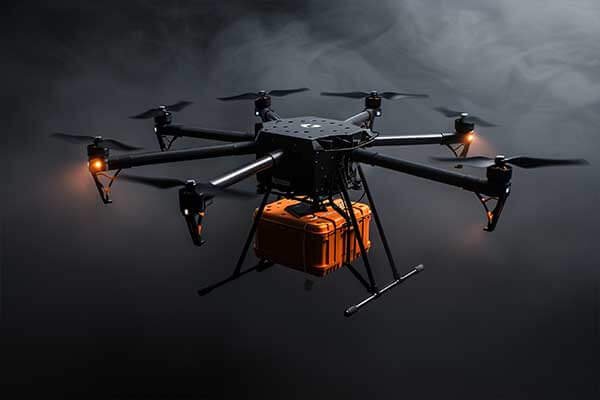
Let's simulate a typical aerial inspection mission with a 488.4 Wh battery:
- Takeoff and Climb (High Power Demand): The drone's motors spin up to maximum RPM to lift the craft and its payload. The power draw might spike to 1,500 Watts for about 30 seconds. The battery must be able to handle this peak demand without its voltage sagging.
- Cruise to Inspection Site (Medium Power Demand): The drone flies at a steady speed. The power draw stabilizes at around 600 Watts. This is the primary phase where the battery's Watt-hour capacity is drained.
- Hover and Inspect (Low Power Demand): The drone hovers in place to capture imagery. Power consumption drops to around 450 Watts.
- Return to Home (Medium Power Demand): The drone flies back, again consuming around 600 Watts.
- Landing (Low Power Demand): The drone reduces motor power to descend, drawing minimal Watts.
The battery's Watt-hour capacity (the "fuel tank") is being drained throughout this entire process. The mission's success depends on whether the 488.4 Wh is enough to cover the total energy consumed across all phases, while the battery's Watt rating ensures it can handle that initial 1,500 W spike without failing.
Conclusion
Watts measure power (speed/strength), while Watt-hours measure energy (endurance/fuel). You need enough Watts to get the job done and enough Watt-hours to finish the mission. Both are crucial for smart battery selection.